Float switches and ultrasonic sensors both tell you where the liquid is in a tank, but they answer different questions and they fail in different ways. A float switch reports a point. An ultrasonic sensor reports a continuous measurement. Picking between them starts with what your process actually needs to know, then works through the media, the tank, and how the output has to be used.
LiquidLevel builds both. This post lays out where each one fits so you can walk into the spec conversation already knowing which direction you’re heading.
The Core Difference: Point Level vs. Continuous Level
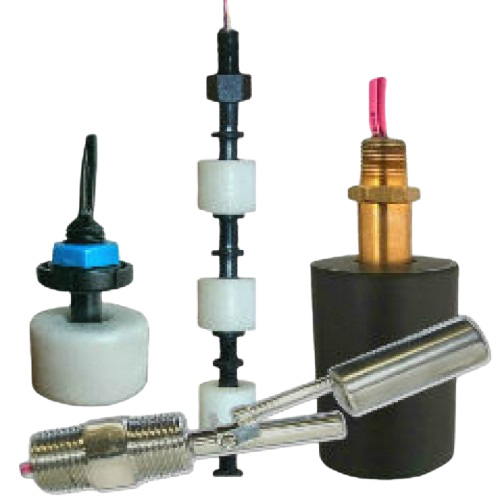
A float switch is a point-level device. A buoyant float rides the surface, and when the liquid crosses a set elevation, the float actuates a switch that opens or closes a circuit. You get a discrete signal at one or more fixed points: high, low, or several stations on a single stem. That’s the entire output. It tells you the liquid is above or below a line, not where it sits between lines.
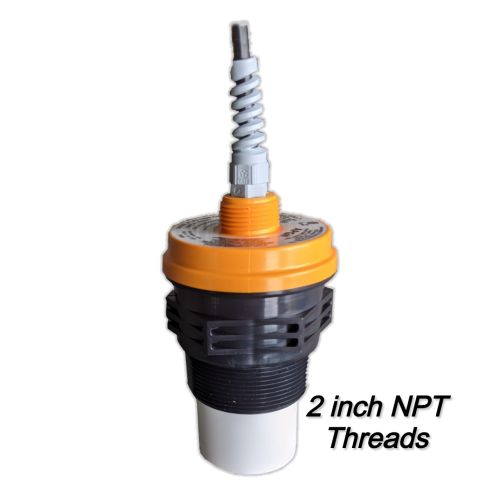
An ultrasonic sensor is a continuous-level device. It mounts at the top of the tank and fires a sound pulse at the surface, then measures the time for the echo to return. That time-of-flight converts to distance, and distance converts to level. The output is an analog signal, usually 4-20mA or 0-10V, that tracks the surface across the full range of the tank.
So the first question is simple. Do you need to act at a set point, or do you need to know the level at every moment? Point control is float switch territory, with one wiring detail worth being precise about. A single float switch can drive an alarm or a simple cutoff on its own, but a start-at-low, stop-at-high pump or valve cycle needs a dual-level control relay between the switches and the load. Two float switches feed the relay: the first switch energizes it, and it stays energized until the liquid reaches the second switch. That latching action is what creates the gap between your start and stop points. If the answer is instead “trend inventory, calculate volume, or feed a level reading to a PLC,” that’s continuous measurement, and ultrasonic is built for it.
Where Float Switches Win
Float switches earn their place on reliability and directness. The mechanism is mechanical, the contacts can be dry, and the switch itself needs no power to do its job. A single switch closes a circuit and drives an alarm or a simple cutoff without a signal conditioner or controller in between. Add a dual-level control relay and two switches, and you have automatic pump or valve control with a defined start and stop. That makes float switches the default for direct control and for installations where power at the sensor is limited.
They also handle multi-point control cleanly. A multi-station vertical switch carries high, low, and intermediate set points on one stem through one penetration, which keeps wiring and tank openings to a minimum.
The limitation is contact. Because the float rides in the liquid, media that coats, crystallizes, or carries heavy solids can foul the float or bind the stem. Sticky product, high-viscosity liquid, or slurry with suspended solids can slow a float or stop it. In clean water, oil, fuel, and most process liquids, that’s a non-issue and the switch runs for years. In the messy stuff, contact becomes the thing to design around.
Where Ultrasonic Sensors Win
Ultrasonic measurement is non-contact. Nothing enters the liquid, which removes the fouling and binding problems that a float faces. That makes ultrasonic a strong fit for corrosive, sticky, or waste liquids where you’d rather keep hardware out of the media entirely. It also scales to depth. The ULS series measures continuously in tanks up to 30 feet, which suits tank farms and large outdoor storage where a mechanical stem isn’t practical.
Because the output is a live analog signal, ultrasonic feeds inventory tracking, volume calculation, and process trending straight into a display or controller. The ULS-150-S, for example, gives 4-20mA and 0-10V outputs, is push-button teachable for field calibration without software, and sits in a 316 stainless NEMA 4x housing on a 1-1/2 inch NPT thread. That’s a sensor built to drop into a PLC-driven line.
The tradeoff is that ultrasonic needs a clean shot at the surface. The pulse has to leave the transducer, reflect off the liquid, and come back. Anything that scatters or absorbs that pulse degrades the reading. Heavy foam absorbs sound and can swallow the echo. Thick vapor, steam, or condensation on the transducer face distorts it. Hard turbulence or an agitated surface scatters the return. Internal obstructions like ladders, fill pipes, or baffles in the beam path can throw false echoes, so mounting position matters. There’s also a dead band close to the sensor face where it can’t read, which sets a minimum distance to the highest liquid level. And the sensor needs power, typically 24VDC, to run at all.
Reading Your Application
A few questions sort most of these cases quickly.
What do you need to do with the reading? Direct on/off control of a pump or valve points to a float switch. A live level value going to a controller or display points to ultrasonic.
What’s the surface like? A calm, clean surface is friendly to ultrasonic. Foam, vapor, steam, or violent agitation works against it and often tips the decision back to a float, or to a stilling well if you want to keep ultrasonic.
What’s the media? Clean liquids are fine for a float. Corrosive, sticky, or high-solids liquids that would foul a float favor non-contact ultrasonic, as long as the surface stays readable.
Is power available at the sensor? A passive float switch can drive a load with no supply. Ultrasonic needs 24VDC.
How deep is the tank, and do you need one point or the whole range? Point control at modest depth is float switch territory. Continuous readout, especially in tall or large tanks, is ultrasonic.
Plenty of installations use both. A float switch handles a hard high-level cutoff or an alarm while an ultrasonic sensor trends the working level for inventory. The two aren’t rivals so much as tools for different jobs, and pairing them gives you continuous data with an independent mechanical backstop on the level that matters most.
Talk It Through Before You Order
The clean way to land this is to match the device to the process, the media, and the output your system expects. If you’re still weighing the two, that’s exactly the call our engineers have every day.
Browse our float switches and our ultrasonic level sensors, or talk to an engineer about your tank and application. We manufacture both in the USA, customize to spec, and a real person picks up the phone.